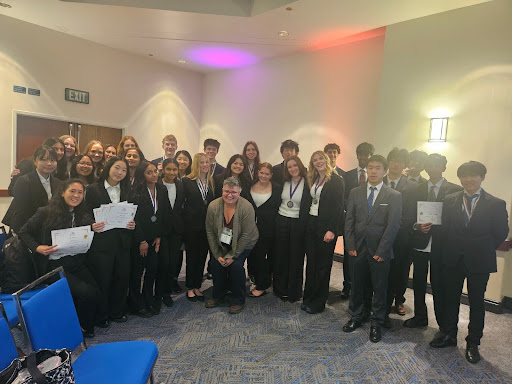













Artificial intelligence is quickly becoming a part of everyday life in classrooms, changing how students learn and how teachers manage their responsibilities. From helping with homework to organizing lesson plans, AI tools are now widely accessible. However, as AI use increases, so does the debate about its impact. In interviews with teachers Keith Barnes (AP Environmental Science) and Maura Goddard (History and Law), and students Zachary Augustine (Sr.), Lucas Mellen (Jr.), and Alexia Segoviano (So.), it became clear that AI brings both significant benefits and concerns. While each person had a different perspective, they all agreed that the way AI is used will ultimately determine whether it strengthens or weakens education. I even decided to ask AI itself for its perspective, so we will see what it has say on its potential world domination.
What are the Benefits of AI use?
Students and teachers consider both sides of the issue.
Teacher: Kieth Barnes-AP Environmental Science
I am excited about the benefits of AI, as research and experience show us that highly experienced workers can gain a lot of value from using this new tool.
I worry that many people are using AI to shortcut their own thinking, and thus, it is taking away their opportunities to learn and is effectively making them dumber.
Both of those ideas put together mean that there might be an even bigger difference between highly successful people and less successful people in the future.
Teacher: Maura Goddard, U.S. History 11, Practical Law/Criminal Justice 101
I think the benefits of using AI can include using it selectively to review their work before they turn things in, looking for grammar errors, or using it to start a project to give them ideas.
My concern with AI is that I’m seeing students become very dependent on it, like it’s their first go-to when they’re looking for something. IfI ask a question in class, hoping that they will research it and learn what they think about the topic, they instead go to Chat GPT and ask the question, and then just paste in what AI tells them is the answer. I’m concerned that students relying on a tool like that will lose some of their ability to discern information for themselves, and they will rely too much on other people’s thoughts and ideas.
Zachary Augustine (Sr.)
If Generative AI is trained on specific areas of research (biology, physics, medicine, etc.), it may be able to vastly accelerate the speed of that research and allow us to progress scientifically and technologically by leaps and bounds.
I have multiple concerns with the usage and progression of generative AI; my largest concern is that of tech companies all racing towards AGI (Artificial General Intelligence), an AI trained on the total sum of all human knowledge, to grant it superintelligence. Such an intelligence poses an existential threat to humanity as a species, especially if we give it digital and political power and influence. Even the CEOs of these tech companies (OpenAI in particular) have stated in interviews that this technology could send humanity to extinction, but is ‘worth it’ for the profits. The usage of generative AI in the creative fields (art, animation, literature, etc.) is something I am radically against and believe that it is not only a waste of space, but a waste of energy and of resources, and should be totally and wholly abolished in that regard.
Lucas Mellen (Jr.)
Some benefits of AI (just kind of an overview; there are a lot depending on the person/organization): AI can already do a lot of things that humans can do. It can already type, click, scroll, and interact with a computer the same way humans do. AI is very quickly taking over a lot of the simpler, repetitive, or computer-based jobs. Some examples of these jobs are data entry clerks, telemarketers, translators, proofreaders, and basic customer service representatives. Although there are a lot of good things, that doesn’t mean there are no bad.
Some bad things from AI include the way it changes our brains. Studies have shown that people are becoming more dependent on AI to think and make decisions—even simple things like what to have for dinner. With AI taking jobs, a lot of people don’t have a way to earn income.
Alexia Segoviano (So.)
AI can be beneficial in many different ways, including using it to create flashcards to use it for studying. Another benefit of AI use is instant feedback, which then gives the students an opportunity to have AI check their assignments for them. AI usage is beneficial because it can help teachers who have a work overload, freeing up their time to plan assignments/put together presentations. There are many ways that AI usage can be beneficial not only to students but to teachers as well.
Though AI usage has some major concerns as well. For example, students can use AI to cheat, and this leads to a poor understanding of the subject. AI usage decreases human interaction, especially from the student to the teacher, because the student might ask questions to AI and not ask the teacher as much anymore. AI can be incorrect, leading to misinformation being spread.
While each person had a different perspective, they all agreed that the way AI is used will ultimately determine whether it strengthens or weakens education.
But what did AI have to say when asked this question?
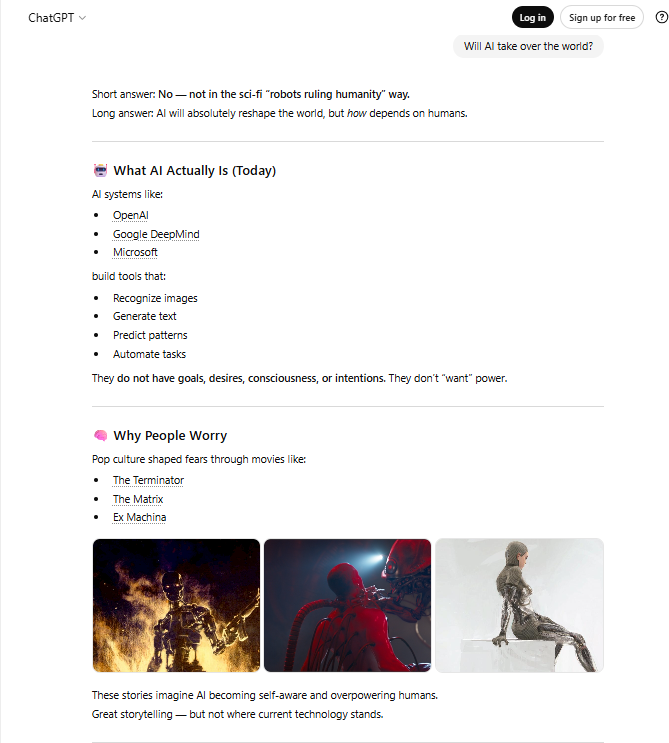
I went to ChatGPT and typed in the following question: Will AI take over the world?
The short answer was: “No, not in the sci-fi ‘robots ruling humanity’ way.
Long answer: AI will absolutely reshape the world, but how depends on humans,” said ChatGPT. It continued to talk about some realizations.
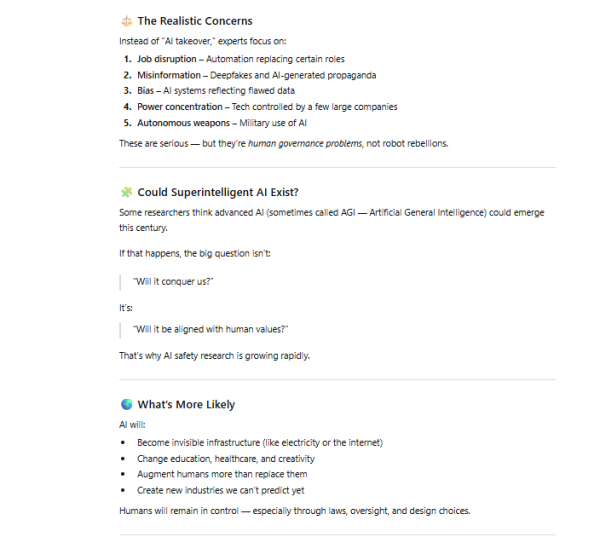
AI shares realistic concerns according to ChatGPT.
What do you think? One thing is for sure: AI is constantly evolving and moving very quickly. Will it take over the world? Only time will tell.